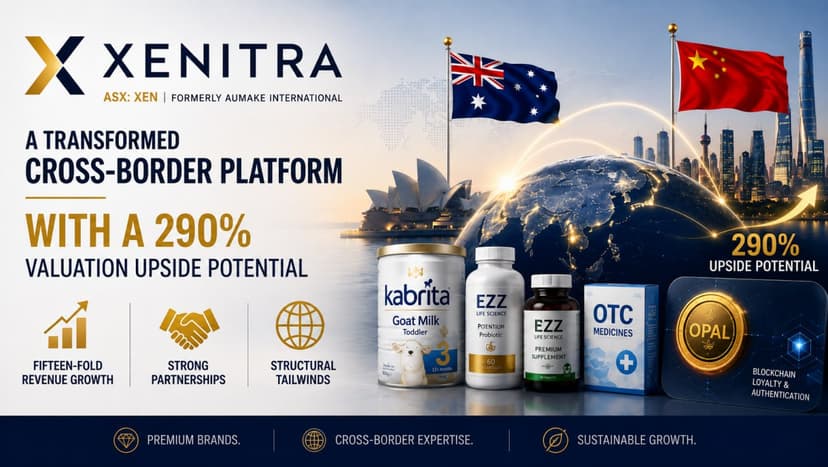
Xenitra (ASX: XEN) has transformed from a tourism-dependent retailer into a diversified cross-border platform connecting Australian and New Zealand health and consumer brands with Greater China. Revenue has grown roughly 15-fold from A$2.7m in FY23 to A$39.8m in FY25, while the company remains valued at only ~0.3x FY25 sales. With growth across nutritionals, OTC medicines and its OPAL platform, supported by major partnerships and favourable Chinese market tailwinds, Xenitra appears positioned for significant margin and earnings growth. A DCF valuation of A$0.0096–A$0.0137 per share implies substantial upside from the current A$0.003 share price.
.webp&w=828&q=75)
Benz Mining Corp (ASX: BNZ) advances its Glenburgh Gold Project toward resource definition, delivering high‑grade intercepts, strong funding, and district‑scale potential that positions it as one of Australia’s most aggressive gold growth stories.
.webp&w=828&q=75)
Peet Limited (ASX: PPC) delivers triple‑digit earnings growth, margin expansion, and upgraded FY26 guidance, underpinned by strong residential demand and disciplined capital management.
IDP Education (ASX: IEL) delivers disciplined cost control and yield growth amid policy‑driven volume pressure, positioning for recovery through transformation, AI‑enabled efficiency, and upgraded FY26 EBIT guidance.
.webp&w=828&q=75)
Myer Holdings (ASX: MYR) delivers strong 1H26 sales growth, disciplined cost control, and record cash generation, reinforcing operational momentum and strategic execution across its integrated retail and apparel platform.
.webp&w=828&q=75)
Sunrise Energy Metals (ASX: SRL) advances its Syerston Scandium Project toward FID, expands production scope, and deepens downstream exposure through U.S. semiconductor investment, positioning for structural re‑rating amid tightening scandium supply.